
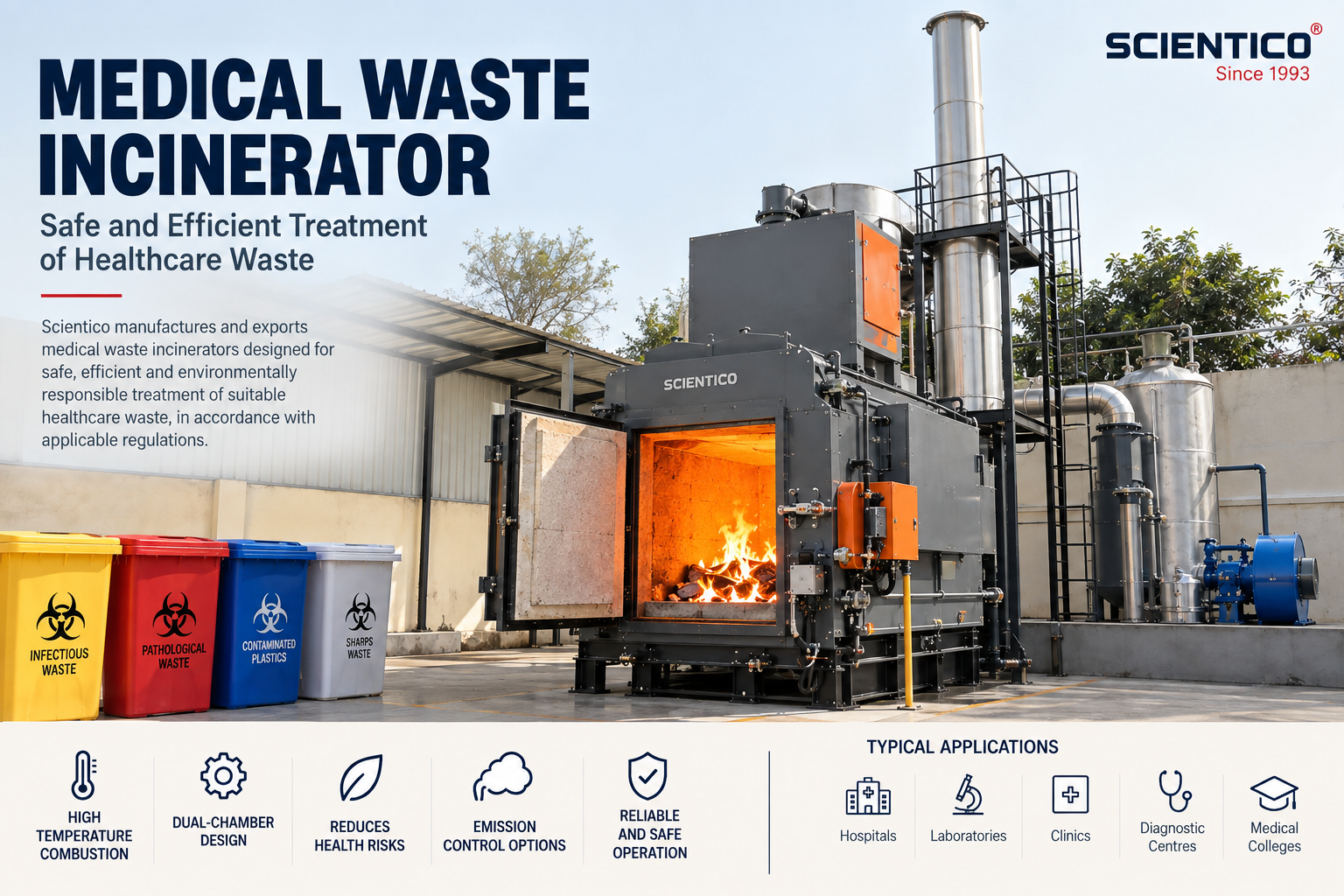
A medical waste incinerator is a controlled thermal treatment system used for suitable healthcare and biomedical waste. It is commonly designed with primary and secondary combustion chambers to provide controlled burning and further oxidation of combustible gases.
Hospitals, laboratories, clinics, veterinary facilities, medical colleges and other healthcare institutions must first identify and segregate their waste streams before selecting an appropriate treatment technology. The World Health Organization notes that healthcare waste includes infectious, pathological, sharps, chemical, pharmaceutical and other waste categories, and that treatment requirements depend on the nature of the waste.
This guide explains how a medical waste incinerator works, how capacity is selected, what combustion chambers do, and which factors should be considered before purchasing an incineration system.
What Is a Medical Waste Incinerator?
A medical waste incinerator uses controlled combustion to thermally treat suitable combustible healthcare waste.
Depending on the waste stream and applicable regulations, this can include suitable:
- Infectious healthcare waste
- Pathological waste
- Contaminated materials
- Certain laboratory waste
- Disposable medical materials
- Other approved combustible biomedical waste
Not every type of healthcare waste should be incinerated. For example, radioactive, certain chemical, pharmaceutical and other hazardous streams may require separate treatment or disposal routes.
The WHO recommends segregation and appropriate treatment of different healthcare waste categories rather than treating all healthcare waste as one stream.
How Does a Medical Waste Incinerator Work?
A typical dual-chamber medical waste incinerator operates through several controlled stages.
1. Waste Loading
Suitable waste is loaded into the primary combustion chamber.
The loading method may be manual or mechanized depending on the size and configuration of the system.
The quantity loaded during each cycle should be based on the manufacturer’s recommended operating load rather than simply filling the chamber to its physical maximum.
2. Primary Combustion
The primary chamber provides the first stage of combustion.
Waste is exposed to controlled heat and combustion air. Moisture evaporates and combustible components undergo thermal decomposition and combustion.
The exact operating conditions depend on the waste characteristics and the applicable regulatory requirements.
3. Secondary Combustion
Gases generated during primary combustion move into the secondary chamber.
The secondary chamber provides additional temperature, combustion air and residence time to promote further oxidation of combustible gases.
This is an important part of a properly engineered dual-chamber medical waste incinerator.
4. Flue Gas Treatment
After secondary combustion, the flue gas passes through the exhaust and treatment system.
Depending on the installation and regulatory requirements, equipment may include:
- Cyclone separators
- Venturi scrubbers
- Wet scrubbers
- Gas cooling systems
- Gas analyzers
- Particulate-control equipment
- Draft fans
- Chimneys and monitoring systems
The appropriate configuration should be established from the applicable environmental requirements for the installation.
Primary and Secondary Combustion Chambers
The two chambers have different functions.
| Component | Function |
|---|---|
| Primary chamber | Initial combustion and thermal decomposition |
| Secondary chamber | Further oxidation of combustible gases |
| Burners | Provide controlled heat during startup and operation |
| Combustion-air system | Supplies air required for combustion |
| Temperature sensors | Monitor chamber temperatures |
| Control panel | Controls and monitors operating parameters |
| Flue-gas system | Transfers and, where required, treats combustion gases |
For example, India’s Bio-Medical Waste Management Rules specify operating requirements for biomedical waste incinerators, including minimum primary and secondary chamber temperatures and secondary-chamber gas residence time. These requirements must be checked against the current rules and the conditions applicable to the specific installation.
What Temperature Does a Medical Waste Incinerator Use?
There is no single temperature that applies to every medical waste incinerator worldwide.
Operating temperature depends on:
- Waste composition
- Moisture content
- Incinerator design
- Chamber geometry
- Burner capacity
- Combustion-air supply
- Residence time
- Applicable environmental regulations
For installations in India, the Bio-Medical Waste Management Rules specify minimum operating conditions for biomedical waste incineration. The current applicable requirements should always be confirmed with the relevant State Pollution Control Board before equipment is specified.
This is important because temperature alone does not determine combustion performance. Proper combustion also depends on residence time, mixing, oxygen availability and the characteristics of the waste.
How to Select Medical Waste Incinerator Capacity
Capacity should be calculated from the actual incinerable waste stream, not simply from the total waste generated by a hospital.
A healthcare facility may generate general waste, recyclable material, infectious waste, pathological waste, sharps, pharmaceutical waste and other categories. These streams can have different treatment requirements.
A practical capacity assessment should consider:
- Waste type
- Average daily quantity
- Peak daily quantity
- Incinerable fraction
- Batch loading requirement
- Number of operating cycles
- Required operating hours
- Waste moisture content
- Available fuel
- Local regulations
The correct approach is therefore:
Segregate → Measure → Identify the incinerable fraction → Determine operating schedule → Select capacity
This approach can prevent purchasing a substantially oversized or undersized machine.
For additional guidance, see our Incinerator Buying Guide: Sizing and Specification.
Medical Waste Incinerator Fuel Options
Depending on the equipment design and site conditions, a medical waste incinerator may use:
- Diesel
- LPG
- Natural gas
- PNG
- Other approved liquid or gaseous fuels
- Electric heating for selected smaller applications
Fuel consumption depends on the waste characteristics and operating conditions.
Important factors include:
- Moisture content
- Waste composition
- Initial chamber temperature
- Burner efficiency
- Insulation
- Loading pattern
- Operating cycle
- Required chamber temperature
Therefore, fuel-consumption figures should always be associated with a defined waste type and operating condition.
Medical Waste Incinerator Emission Control
Emission control is an important part of medical waste treatment.
The World Health Organization warns that inadequate incineration or incineration of unsuitable materials can result in pollutants including particulate matter, dioxins and furans. It notes that modern incinerators with appropriate gas-cleaning systems are required where strict emission control is necessary.
Depending on the project, an emission-control system may incorporate:
Primary chamber → Secondary chamber → Gas cooling/treatment → Scrubber/cyclone where required → Chimney
The exact configuration should be based on the applicable emission standards and site requirements rather than using the same arrangement for every project.
Why Is Refractory Lining Important?
The combustion chambers of a medical waste incinerator are exposed to high temperatures and repeated thermal cycles.
Refractory lining helps:
- Protect the steel chamber structure
- Reduce heat loss
- Maintain combustion temperatures
- Withstand thermal cycling
- Provide insulation
The refractory material and thickness should be selected according to the intended operating conditions and equipment design.
Medical Waste Incinerator Applications
A medical waste incinerator may be considered for suitable waste streams generated by:
- Hospitals
- Medical colleges
- Diagnostic centres
- Laboratories
- Research institutions
- Clinics
- Veterinary hospitals
- Healthcare waste-treatment facilities
Whether an organization should install its own incinerator depends on its waste quantity, location, available common treatment facilities and applicable regulations.
In India, for example, the Bio-Medical Waste Management Rules address the use of in-house incinerators and require authorization from the State Pollution Control Board in circumstances specified by the rules.
Medical Waste Incinerator vs Autoclave
Incineration is not the only treatment technology available for healthcare waste.
Depending on the waste category and regulatory requirements, alternatives can include:
- Autoclaving
- Steam treatment
- Microwaving
- Chemical treatment
- Other approved treatment technologies
The WHO provides guidance comparing technologies for treatment of infectious and sharp healthcare waste and recommends that technology selection consider technical, financial, environmental and operational requirements.
The correct technology therefore depends on the specific waste stream rather than the general label “medical waste.”
Important Features to Check Before Buying
When evaluating a medical waste incinerator, buyers should check:
Combustion system
- Primary chamber
- Secondary chamber
- Burner arrangement
- Combustion-air system
- Temperature monitoring
Construction
- Chamber dimensions
- Refractory specification
- Door construction
- Ash-removal arrangement
- Insulation
Control system
- Temperature controller
- Safety interlocks
- Burner controls
- Alarm system
- Control panel
Emission control
- Scrubber requirements
- Cyclone requirements
- Gas monitoring
- Draft system
- Chimney requirements
Documentation
- Technical datasheet
- General arrangement drawing
- Electrical details
- Fuel requirements
- Operating instructions
- Maintenance information
- Factory testing documentation
Medical Waste Incinerator Manufacturer
Scientico manufactures and exports dual-chamber incinerators for biomedical, veterinary, animal, poultry and general waste applications from its manufacturing facility in Ambala, India. The company’s incinerator range is configured according to waste type, capacity, fuel and project requirements.
For biomedical waste projects, the technical configuration should be checked against the requirements applicable to the actual installation. Scientico’s Biomedical Waste Incinerator Manufacturer India Guide provides additional information for buyers evaluating capacity, regulatory requirements and procurement documentation.
Questions to Ask a Medical Waste Incinerator Manufacturer
Before requesting a quotation, provide:
- Type of waste
- Average daily waste quantity
- Peak daily waste quantity
- Estimated incinerable fraction
- Required batch capacity
- Required operating hours
- Country of installation
- Available fuel
- Available electrical supply
- Required emission-control equipment
- Available installation space
- Applicable regulatory requirements
Providing this information allows the manufacturer to recommend a system based on the actual application rather than a generic catalogue model.
Why Choose Scientico?
Scientico has manufactured and exported equipment from its works in Ambala, Haryana since 1993. Its product range includes incinerators as well as laboratory, medical, nursing, pharmacy and engineering training equipment.
For an equipment enquiry, buyers can contact Scientico through the official contact page and provide their waste type, quantity and destination.
Conclusion
A medical waste incinerator is a specialized thermal treatment system that must be selected according to the actual waste stream, required capacity, combustion conditions and environmental requirements.
The most important factors are not simply the size of the furnace. Buyers should evaluate the complete system, including the primary and secondary combustion chambers, burner system, air supply, refractory construction, controls, flue-gas treatment and regulatory requirements.
Before purchasing, measure the actual incinerable waste stream and confirm the requirements applicable to the installation. This provides a more reliable basis for selecting an appropriately sized and configured medical waste incinerator.